
A need takes shape.
Social, video, content, referrals and offline experiences can build awareness or activate a need.
GOOGLE ADS · SEARCH CAMPAIGN OPERATING FRAMEWORK
An applied Google Ads Search framework connecting business context, campaign planning and keyword structure with data signals, Smart Bidding, performance diagnosis and growth where demand can be acquired efficiently.
SEARCH · INTENT · VALIDATION
Discovery may start through social, video, content or word of mouth. Search becomes valuable when the need turns active: people compare, verify and evaluate options, expressing intent through their queries.
Social, video, content, referrals and offline experiences can build awareness or activate a need.
People compare solutions, reviews, prices, availability and providers. Their intent becomes more observable.
A call, form, booking, quote request or purchase. Search needs to connect with the outcome that matters to the business.
BUSINESS TRUTH · BEFORE THE CLICK
Before a media plan comes the commercial model: what counts as a conversion, how often it becomes a sale, what a customer is worth and what acquisition cost the business can support.
CAMPAIGN BLUEPRINT · PLAN BEFORE PLATFORM
Campaign planning comes before platform setup. Structure is decided and reviewed in advance, reducing rushed decisions and setup friction. Google Ads becomes the environment for executing a considered plan.
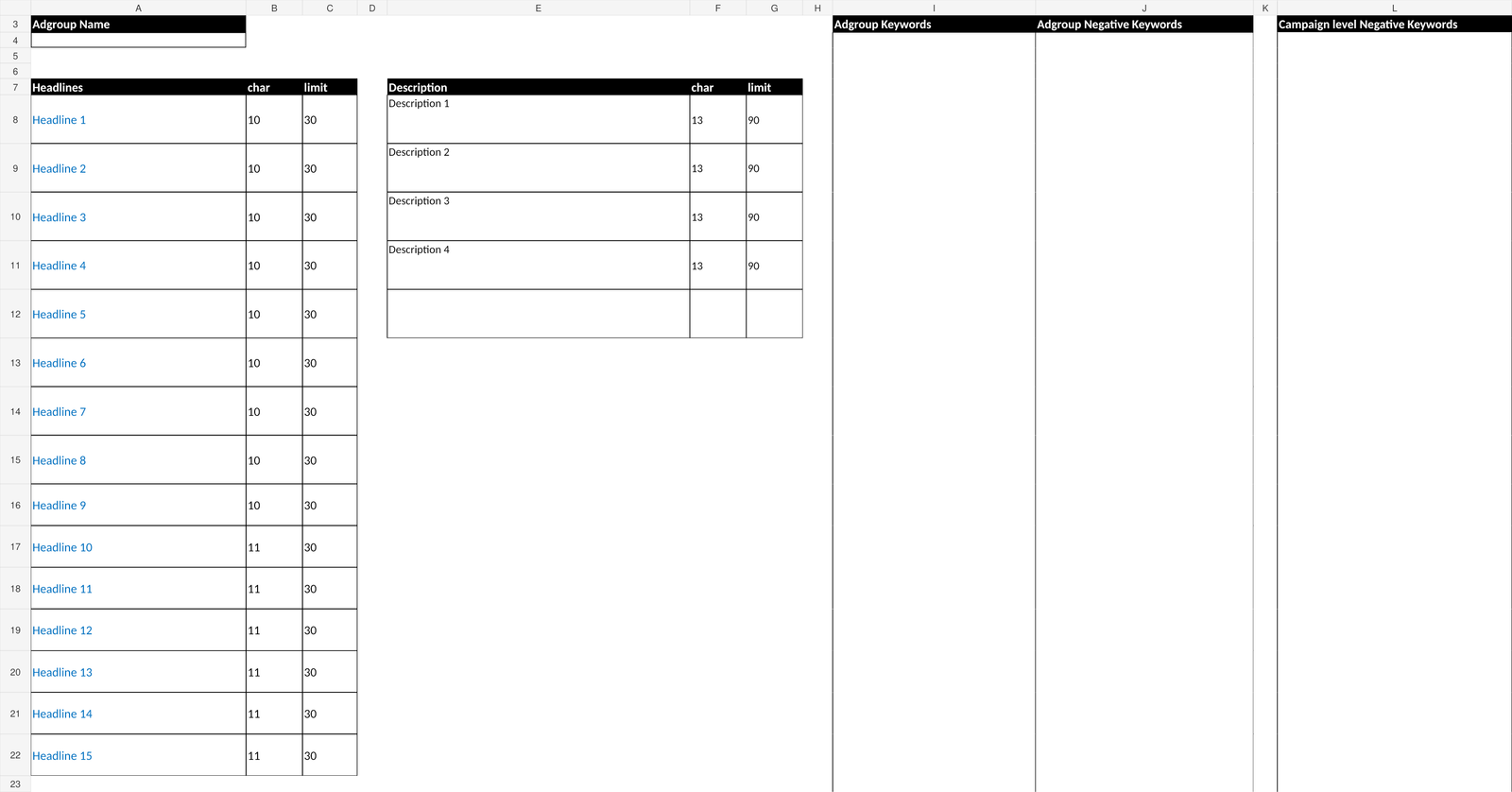
A practical portfolio resource, free to use or adapt when planning Google Ads Search campaigns.
The spreadsheet brings together ad groups, keywords, negative keywords, RSA headlines and descriptions, and landing-page alignment.
SEARCH ARCHITECTURE · DEMAND → STRUCTURE
Campaigns and ad groups keep shared intent together and separate demand that needs different management. Structure should serve the business, without unnecessary complexity.
Start with real customer needs and how people express them in search.
Align business objective, budget, geography and bidding logic. For example: AC Repair ≠ Heat Pumps.
Group related intent so keywords, ads and landing experiences stay consistent.
Define eligibility and guardrails: what should trigger an ad and what should be excluded.
The message and destination should continue the need expressed in the query.
Useful for a narrower semantic scope and deliberate coverage of core demand.
Broader coverage than exact match, with more flexibility in close variants and query interpretation.
Open-ended coverage becomes more useful with strong conversion signals and Smart Bidding.
DATA STRENGTH · MEASUREMENT INFRASTRUCTURE
Conversion tracking also feeds the bidding system. The task is to connect, strengthen and activate signals that reflect business reality as accurately as possible.
The core measurement layer for website actions, campaign attribution and conversion setup.
Improve observability using privacy-conscious first-party, user-provided data when standard signals are lost.
Strengthens first-party tagging resilience and collection of ad-interaction signals through advertiser-controlled infrastructure.
Deduplication prevents conversions and conversion value from being counted twice.
Qualified leads, closed sales and downstream values connect platform signals with meaningful business outcomes.
SIGNAL & VALUE MATURITY
Conversions differ in both information and economic value. For lead generation, connecting forms to qualified leads and sales allows optimization to progress from volume towards business value.
A basic conversion signal. Useful for volume, but it does not establish lead quality.
An earlier downstream signal with a closer connection to the final business outcome.
Actual economic value once the final outcome is available and can be returned to Google Ads.
Predictive value from propensity, expected LTV or other reliable business signals when final value is not yet observable.
There is no fixed timeline. Progression depends on objectives, signal quality, volume, conversion delay and business economics.
OPTIMIZATION METHOD
Optimization starts with evidence: examine what changed, consider possible explanations and test which one the data supports. Then choose an intervention and measure whether it improved the original business objective.
What changed: CPA, volume, CVR, CPC, value or search-term quality?
What could explain the signal?
Which reports and dimensions can support or reject the hypothesis?
Which intervention fits the evidence and constraints?
Did the change improve the real objective or just move an intermediate metric?
Impressions, seasonality, local search volume.
Budget, Ad Rank, competition, impression share.
Search terms, negatives, intent, match-type expansion.
CTR, CPC, ad message relevance.
Landing-page fit, form friction, CVR.
Tracking integrity, qualified leads, sales, conversion delay.
DEMAND-LED GROWTH · BUDGET & FORECASTING
When additional demand remains within agreed CPA or ROAS limits, budget need not be an arbitrary ceiling. Consider funding more demand where the incremental cost or return makes commercial sense. Growth comes from investing where the economics still work.
Additional demand is available without sacrificing acceptable efficiency.
CPA or ROAS remains within the business’s agreed limits.
The campaign could capture more demand, but the available budget restricts coverage.
Increase investment gradually and check that incremental spend continues to meet the business’s efficiency requirements.
Models how different budgets or bidding targets might affect clicks, cost, conversions and value before committing more budget or changing campaign settings.
Helps decide where additional near-term budget could capture more demand while keeping existing performance targets.
Forecasts alternative budget and performance-target scenarios so the business can compare investment choices. Over time, compare the plan with actual performance and adjust for market changes.
AI-POWERED SEARCH · SEARCH BEYOND THE KEYWORD
With AI Max and modern Search systems, control increasingly comes from better inputs, signals and guardrails. The strategic work moves towards designing and evaluating the system.
PROJECT SUMMARY · THE SEARCH OPERATING SYSTEM
The framework connects demand, campaign architecture, data, bidding and measurement. Each outcome provides new information, helping the next decision move closer to the business objective.
This framework shows how user intent, business economics and the signals feeding Google Ads fit together. Its purpose is to demonstrate planning, diagnosis and judgement within an evolving system.